
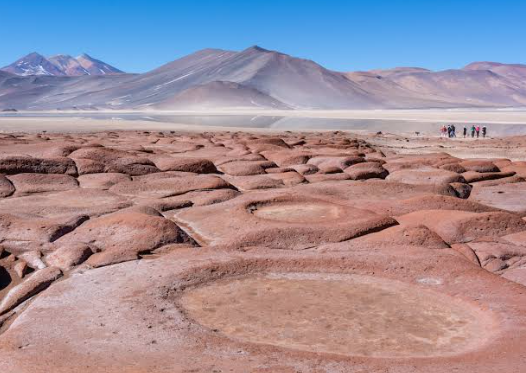
High in the Atacama Altiplano, Piedras Rojas Chile is a striking landscape where rust-red rock formations meet pale salt crusts, shallow blue-green water, and barren volcanic mountains. Its name literally means “Red Rocks,” referring to the broad reddish formations that dominate the shoreline and create one of the most recognizable color contrasts in northern Chile.
Located southeast of San Pedro de Atacama at more than 4,000 meters above sea level, Piedras Rojas belongs to the high-Andean desert environment surrounding the Talar and Aguas Calientes saline system. Chile’s official tourism authority identifies the site with Salar de Talar and explains that the intense red coloration of the rocks is produced by iron oxidation.
Where Is Piedras Rojas Chile?
Piedras Rojas lies in Chile’s Antofagasta Region, southeast of San Pedro de Atacama.
The journey from San Pedro crosses increasingly high terrain, passing through the Atacama Desert toward the Altiplano. Chile Travel places the destination about 150 kilometers from San Pedro and notes that the route rises above 4,000 meters.
At this elevation, the environment changes considerably from the lower desert.
Temperatures are colder, winds can be strong, vegetation becomes sparse, and the surrounding landscape is dominated by high mountains, volcanic formations, salt flats, and shallow lagoons.
The combination of elevation and extreme aridity is one reason the geological features remain so clearly exposed.
Why Are the Rocks Red?
The most distinctive feature of Piedras Rojas is its reddish rock surface.
The color is primarily associated with iron-bearing minerals that have undergone oxidation.
When iron contained in rock reacts with oxygen, it can form iron oxides. These compounds produce red, orange, and brown colors similar to the rust that forms on exposed iron.
Chile Travel specifically identifies iron oxidation as the reason for the intense reddish color of the formations at Piedras Rojas.
Over long periods, weathering exposes and alters the mineral-rich surfaces, producing the broad red formations visible today.
The lack of dense vegetation makes these colors particularly noticeable.
A Landscape Shaped by Volcanism
Piedras Rojas lies within one of the most volcanically active geological regions of South America.
The Andes of northern Chile were formed through long-term tectonic activity associated with the subduction of the Nazca Plate beneath the South American Plate.
This process has produced numerous volcanoes, lava flows, volcanic deposits, and high mountain basins throughout the region.
The mountains surrounding Piedras Rojas are part of this broader volcanic landscape.
Volcanic rocks weather differently depending on their mineral composition, which contributes to the variety of brown, gray, red, and dark tones visible across the Altiplano.
The red formations therefore form only one part of a much larger geological system shaped by volcanism and tectonic uplift.
The Salar de Talar and Aguas Calientes Connection
The geography around Piedras Rojas can sometimes appear confusing because the destination is associated with both Salar de Talar and Salar de Aguas Calientes in published descriptions.
Chile Travel’s dedicated Piedras Rojas page identifies the destination with Salar de Talar, while another official itinerary describes the red formations as lying along Salar de Aguas Calientes.
These names refer to closely connected parts of the same broader high-altitude saline landscape rather than completely separate environments.
For visitors and general geography readers, Piedras Rojas is best understood as the red-rock shoreline associated with this high-Andean salt-flat and lagoon system.
Its appearance is defined by the interaction of volcanic rock, salt deposits, shallow water, and extreme evaporation.
How Did the Salt Flat Form?
Like many salars of northern Chile, the surrounding basin has no easy drainage route to the ocean.
Water enters from precipitation, snowmelt, springs, and runoff from surrounding mountains.
As water moves across volcanic rocks and sediments, it carries dissolved minerals into lower parts of the basin.
Because the climate is extremely dry, much of this water eventually evaporates.
The water disappears, but the minerals remain.
Repeated evaporation gradually concentrates salts and produces pale crusts along the basin floor.
This process explains the sharp contrast between the red rocks and the surrounding white or cream-colored salt deposits.
Why Is the Water Blue or Turquoise?
The shallow lagoons surrounding Piedras Rojas can appear blue, turquoise, greenish, or even milky depending on environmental conditions.
Several factors influence their appearance.
Water depth affects how light is absorbed and reflected, while suspended minerals and fine sediments can change its color. The bright salt crust surrounding the lagoons also increases the visual contrast.
Chile Travel describes the landscape as a combination of oxidized red rocks, white salt, and blue high-altitude lagoons.
Under the clear skies of the Altiplano, this combination creates the dramatic red-white-blue palette for which Piedras Rojas is known.
Wind and Weather Continue to Shape the Rocks
Although the Atacama is extremely dry, its landscapes are still actively weathering.
Strong winds move fine sediment across exposed surfaces.
Large differences between daytime and nighttime temperatures can repeatedly expand and contract rock materials.
Occasional precipitation and freezing conditions at high altitude can also contribute to cracking and erosion.
Over long periods, these processes smooth, fracture, and reshape exposed volcanic rocks.
Many formations at Piedras Rojas therefore have rounded, worn surfaces rather than sharp newly broken edges.
Their present appearance reflects thousands of years of exposure to the harsh Altiplano environment.
Life in an Extreme High-Altitude Environment
The landscape may appear almost lifeless at first, but high-Andean ecosystems support highly specialized plants and animals.
Vegetation is generally sparse, with low shrubs and tough grasses adapted to cold temperatures, dry air, intense sunlight, and limited water.
The wider Atacama puna supports animals adapted to these same conditions. Chile’s protected-area authority records species such as high-Andean grasses and cushion plants across the regional puna ecosystems, while high-altitude lagoons and wetlands provide habitat for specialized birdlife.
Flamingos are among the best-known birds associated with the salt flats and lagoons of the broader Atacama region.
Vicuñas and other high-Andean animals may also be encountered in suitable surrounding habitats.
Why the Altitude Matters
Piedras Rojas sits above 4,000 meters, making altitude one of the defining characteristics of the landscape.
Atmospheric pressure is significantly lower than at sea level, meaning less oxygen is available with each breath.
The high elevation also contributes to large temperature variations, intense ultraviolet radiation, and strong winds.
Chile Travel advises visitors to acclimatize before traveling to Piedras Rojas, drink sufficient water, avoid excessive physical exertion, and prepare for cold and strong sun.
These conditions are not incidental—they are part of the environmental system that shapes both the geology and ecology of the region.
Piedras Rojas Compared With Other Atacama Landscapes
The Atacama Desert contains several famous geological environments, but each has a different character.
Valle de la Luna is dominated by eroded ridges, salt formations, and dune-like terrain.
Salar de Atacama is known for its enormous salt crust and flamingo lagoons.
El Tatio is shaped by geothermal activity.
Rainbow Valley displays multicolored mineral-rich mountains.
Piedras Rojas stands apart because of the particularly strong contrast between its iron-red rocks, pale salt deposits, blue-green water, and surrounding volcanic peaks.
This variety illustrates why the Atacama cannot be understood simply as a flat sandy desert.
It contains volcanoes, salt basins, geothermal systems, wetlands, canyons, dunes, and mineral-rich mountain landscapes.
A Geological Landscape Built From Color
The distinctive appearance of Piedras Rojas Chile is the result of several geological processes working together.
Volcanism supplied the rocks and minerals. Iron oxidation produced the characteristic red tones. Closed-basin drainage and intense evaporation concentrated salts in the surrounding lowlands. Wind, temperature changes, and erosion gradually shaped the exposed rock surfaces.
The result is a landscape where geology can be read almost directly through color.
Red rock marks iron-rich weathered surfaces, pale crusts reveal mineral accumulation, and shallow blue-green lagoons occupy depressions within the high-altitude basin.
Together with the barren volcanic mountains of the Altiplano, these features make Piedras Rojas one of the clearest examples of how tectonics, volcanism, mineral chemistry, climate, and erosion combine to shape the extraordinary geography of northern Chile.