
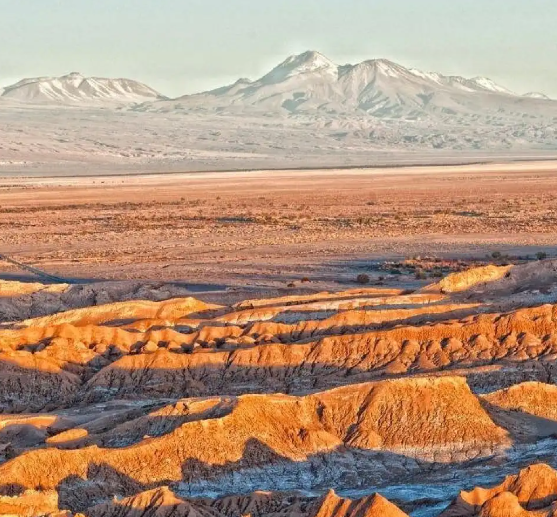
Hidden among the dry mountains of northern Chile, Rainbow Valley Chile, known locally as Valle del Arcoíris, is one of the most colorful geological landscapes near San Pedro de Atacama. Its hills contain striking bands of red, green, yellow, white, gray, and purple rock, creating a landscape that looks dramatically different from the pale salt flats and brown volcanic plains found elsewhere in the Atacama Desert.
The colors are not painted onto the mountains. They are the visible result of different rock types, minerals, chemical alteration, tectonic deformation, and millions of years of erosion. Chile’s official tourism authority describes the valley as an area of reddish, green, and yellow terrain whose colors originate from mixtures of minerals, clay, and iron.
Where Is Rainbow Valley Chile?
Rainbow Valley lies in northern Chile’s Antofagasta Region, within the broader Atacama Desert landscape near San Pedro de Atacama.
It is located in the Río Grande area and associated with the Cordillera de Domeyko, a mountain range running roughly parallel to the Andes. Chile Travel places the valley approximately 90 kilometers from San Pedro de Atacama.
The landscape sits above 3,000 meters in elevation, where dry air, sparse vegetation, strong temperature changes, and exposed rock dominate the environment.
Unlike the very high Altiplano farther east, Rainbow Valley occupies a transitional desert mountain environment where ancient geological layers are unusually easy to see.
Why Is It Called Rainbow Valley?
The name comes from the unusual concentration of different colors visible across the hillsides.
Instead of one dominant rock color, neighboring slopes may contain red, orange, pale yellow, green, white, gray, and violet zones.
This variation reflects differences in the mineral and chemical composition of the rocks.
Some layers formed as sedimentary deposits, while others are associated with igneous activity and later mineral alteration. Tectonic forces subsequently folded, fractured, and uplifted these rocks, bringing contrasting geological units close together.
Erosion then removed overlying material and exposed them at the surface.
The result is the multicolored landscape that gives Rainbow Valley Chile its name.
What Makes the Rocks Red?
Red is one of the most prominent colors in the valley.
These tones are strongly associated with iron-bearing minerals that have undergone oxidation.
When iron reacts chemically with oxygen, it can produce iron oxides that give rocks red, orange, and rusty colors. Similar processes are responsible for the red coloration of many desert landscapes around the world.
The Atacama’s extremely dry environment helps keep these exposed rock surfaces visible because dense vegetation does not cover the slopes.
Over long periods, wind and occasional water erosion expose fresh layers, allowing different shades of iron-rich rock to appear side by side.
Where Do the Green Colors Come From?
Green is one of the features that makes Rainbow Valley especially unusual.
Local geological observations describe green rocks containing minerals such as chlorite and actinolite associated with altered igneous rocks.
Other descriptions of the valley also connect its green and blue-green colors with mineral alteration in chemically distinctive rocks.
It is therefore more accurate to think of the valley’s colors as the result of multiple geological processes rather than assigning every shade to a single mineral.
Different original rocks, groundwater chemistry, oxidation conditions, and hydrothermal alteration can all affect color.
White, Yellow, and Purple Layers Add More Contrast
The lighter colors come from another group of materials.
White and pale areas can contain gypsum, salts, light-colored clays, and other mineral deposits. Yellow and ochre colors may occur where iron minerals and clay have undergone different degrees of oxidation.
Purple rocks are also visible in parts of the area.
These contrasting layers are particularly important because they show that the valley was not formed during one simple geological event.
Instead, different environments deposited different materials at different times.
Some sedimentary rocks in the wider valley are extremely old, while later igneous and pyroclastic materials record subsequent episodes of geological activity.
Tectonic Forces Helped Create the Landscape
Color alone does not explain the unusual appearance of Rainbow Valley.
The structure of the mountains is also important.
Northern Chile lies within an intensely active tectonic region created by the long-term interaction between the Nazca and South American tectonic plates.
These forces helped uplift and deform the Andes and neighboring mountain ranges, including the Cordillera de Domeyko.
In Rainbow Valley, rock layers can be tilted, folded, fractured, and exposed at unusual angles.
Rather than seeing neat horizontal layers stacked one above another, visitors can observe contrasting geological units brought together by deformation.
This structural complexity helps explain why so many different colors can appear within a relatively small area.
Erosion Revealed the Colored Rock
The valley’s unusual geology would be much less visible without erosion.
Although the Atacama is one of the driest regions on Earth, erosion still occurs.
Wind gradually removes loose material, while rare rainfall events can produce temporary streams capable of cutting gullies and channels into the soft rock.
Temperature changes also contribute to physical weathering. Rocks repeatedly heat and cool, encouraging fractures to develop over time.
Chile Travel specifically identifies erosion as an important process responsible for the valley’s distinctive rock formations.
The landscape visible today is therefore the combined result of geological construction and gradual destruction: rocks were deposited, uplifted, altered, and then carved open by erosion.
Why the Atacama Desert Preserves the Colors So Well
Rainbow Valley’s location in the Atacama Desert is one reason its geology remains so exposed.
In wetter climates, soil and vegetation can hide much of the underlying bedrock.
The Atacama’s extreme aridity limits plant growth across many slopes. As a result, rock surfaces remain visible for long periods.
Limited rainfall also means that some soluble minerals and surface deposits can persist longer than they would in humid environments.
This allows visitors to see differences in mineralogy directly across the landscape rather than having them concealed beneath thick soil or forests.
The desert effectively turns the mountains into an open geological display.
Yerbas Buenas Adds a Human History to the Landscape
Rainbow Valley is often associated with the nearby archaeological site of Yerbas Buenas.
The area contains numerous petroglyphs carved into rock surfaces. Images include animals, human figures, and other symbols connected with people who traveled through the Atacama region.
Chile Travel describes Yerbas Buenas as an important rock-art site near Rainbow Valley and notes the long human history represented there.
The location was connected with routes used by people moving between the high Andes and lower desert regions.
This creates an interesting combination of geological and cultural history.
The colored rocks tell a story extending millions of years into Earth’s past, while the nearby carvings record a much more recent period of human movement across the desert.
A Different Side of the Atacama Desert
Many famous Atacama landscapes are associated with salt.
Salar de Atacama contains vast salt deposits, Valle de la Luna displays salt-rich formations, and high-altitude salars dominate parts of the Altiplano.
Rainbow Valley Chile is different.
Its main visual feature is the variety of exposed rocks and mineral colors within the Domeyko mountain environment.
Red cliffs stand beside green and pale mineralized slopes. Purple and gray layers appear between eroded ridges, while narrow valleys reveal the complicated structure beneath the mountains.
This makes the area especially useful for understanding that the Atacama Desert is not one uniform landscape.
It contains salt basins, volcanoes, dunes, ancient sedimentary rocks, high-altitude wetlands, geothermal systems, and multicolored mountain ranges.
Rainbow Valley Is a Geological Record in Color
The beauty of Rainbow Valley Chile comes from processes that occurred over enormous spans of time.
Sediments accumulated under ancient environmental conditions. Igneous activity introduced additional rocks and minerals. Chemical alteration changed their composition, tectonic forces folded and uplifted the landscape, and erosion gradually exposed the different layers.
Iron-rich rocks created many of the dominant reds and ochres, while altered minerals, clays, gypsum, salts, and other geological materials contributed greens, whites, yellows, grays, and purples.
Today these processes can be read directly across the exposed hillsides.
Rather than being simply a colorful desert attraction, Rainbow Valley is a visible geological archive—one that helps explain the complex history of the Atacama Desert and the mountain systems of northern Chile.