
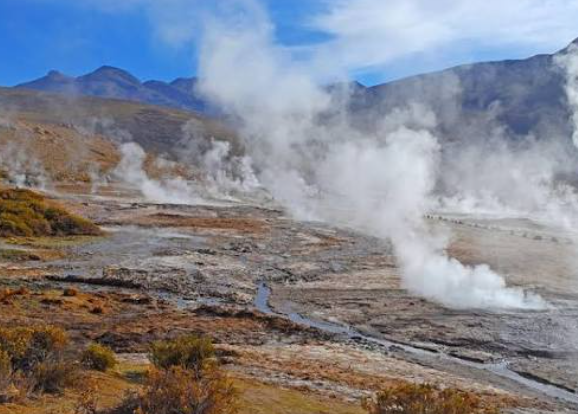
High in the Andes of northern Chile, the El Tatio Geysers form one of the world’s most remarkable geothermal landscapes. Steam rises from vents scattered across a broad volcanic plateau, while boiling springs, bubbling pools, mineral deposits, and occasional geyser eruptions reveal the intense heat circulating beneath the surface.
Located in Chile’s Antofagasta Region, El Tatio lies more than 4,300 meters above sea level. Chile’s official tourism authority describes it as the world’s third-largest geothermal field and one of the most striking natural attractions of the high Atacama region.
Its importance, however, extends far beyond tourism. El Tatio is also a natural laboratory where scientists study geothermal circulation, mineral formation, microorganisms, and the long-term relationship between volcanism and groundwater.
Where Are the El Tatio Geysers?
El Tatio is situated in the Chilean Andes north of San Pedro de Atacama.
The geothermal field occupies a high-altitude basin surrounded by volcanic mountains and the dry landscapes of the Altiplano. The elevation generally ranges between about 4,200 and 4,300 meters, placing El Tatio among the highest major geyser fields on Earth.
At this altitude, environmental conditions can be extreme.
Night and early-morning temperatures frequently fall below freezing, while daytime sunshine can be intense. Low atmospheric pressure also means that the air contains less oxygen than at sea level.
The surrounding landscape includes volcanic slopes, sparse high-altitude vegetation, wetlands, and open plains inhabited by animals such as vicuñas and Andean birds.
Why Is El Tatio Geothermally Active?
El Tatio exists because northern Chile lies within an active volcanic region of the Andes.
This volcanic activity ultimately results from the tectonic setting along the western edge of South America, where the Nazca Plate moves beneath the South American Plate.
Deep underground, heat associated with the Andean volcanic system warms groundwater circulating through fractures and permeable rocks.
The heated water rises toward the surface through faults and other underground pathways.
Scientific studies of El Tatio indicate that its thermal waters are primarily derived from precipitation rather than directly from magma. Water enters the ground in surrounding highlands, circulates through the subsurface, becomes heated, and later emerges within the geothermal field.
This combination of groundwater, underground fractures, and a persistent heat source produces the geysers, hot springs, steam vents, and boiling pools visible today.
How Do the El Tatio Geysers Work?
A geyser requires a relatively specific underground plumbing system.
Water first enters cracks and underground reservoirs. As it moves deeper, geothermal heat raises its temperature.
The water may become extremely hot while remaining liquid because it is under pressure.
As hot water and steam begin moving upward through narrow channels, pressure decreases. Some of the water then boils rapidly, producing expanding steam bubbles.
This expansion can force water and steam upward through the vent as a geyser eruption.
Research on individual geysers at El Tatio has shown that boiling can begin near the upper part of the water column and propagate downward through the conduit. The timing of eruptions is strongly influenced by processes within the geyser’s underground reservoir and plumbing system.
Not every thermal feature behaves like a geyser.
El Tatio also contains continuously flowing hot springs, steam vents, bubbling pools, mud features, and perpetual spouters.
Why Is El Tatio Most Dramatic at Sunrise?
El Tatio is especially famous for the dense clouds of steam visible around sunrise.
This does not necessarily mean that geothermal activity suddenly begins in the morning.
Instead, the cold early-morning air makes hot vapor much more visible.
When warm, moisture-rich air from the geothermal vents mixes with extremely cold surrounding air, water vapor rapidly condenses into tiny droplets. These droplets form the thick white steam clouds seen across the field.
As the sun rises and the atmosphere becomes warmer, the plumes often appear less dense even though hot water and steam continue to escape from the geothermal system.
Chile Travel specifically notes that the extreme morning cold enhances the visible columns of steam, which is why dawn creates such a dramatic landscape.
More Than Just Geysers
Despite its name, the El Tatio geothermal field contains many different hydrothermal features.
Researchers have documented geysers, hot springs, boiling pools, mud features, and vents across the area. A detailed drone survey identified nearly 2,000 individual geothermal features grouped into several major zones.
Many of these features occur along preferred structural directions.
This suggests that underground fractures and geological structures strongly control where hot water can reach the surface.
Understanding these patterns helps scientists reconstruct the hidden geothermal plumbing beneath the field.
Silica Creates Unusual Mineral Landscapes
One of the most important geological products at El Tatio is silica sinter.
The hot water rising through the geothermal system contains dissolved silica. When this water reaches the surface, it cools and evaporates.
Some of the dissolved silica then precipitates and accumulates around hot springs and geyser vents.
Over time, this process forms pale mineral terraces, crusts, channels, rims, and irregular surfaces.
Scientific analysis shows that El Tatio’s sinter is dominated by amorphous silica known as opal-A. Cooling and evaporation are important processes controlling its deposition.
These deposits provide a visible record of where geothermal water has flowed in the past.
Geothermal Activity Has Continued for Thousands of Years
El Tatio is not a newly formed geothermal system.
Research examining silica deposits indicates that hydrothermal activity began approximately 27,000 years ago and has continued almost continuously since then.
More recent geological dating has continued to support a late-Pleistocene origin for geothermal activity in the field.
Some older sinter deposits are located beyond the areas where geothermal activity is concentrated today.
This indicates that vents and springs have shifted position over thousands of years as underground pathways changed.
The modern geyser field therefore represents only the current surface expression of a much older hydrothermal system.
Microorganisms Live Around the Hot Springs
The extreme environment of El Tatio also makes it scientifically important for biology.
Microbial communities can survive in and around geothermal water where temperatures and chemical conditions would be unsuitable for many other forms of life.
Microorganisms may form mats along channels, pools, and mineral deposits.
Because similar microbial communities can interact with silica and leave structures preserved within mineral deposits, geothermal fields such as El Tatio are useful for studying how evidence of ancient life may be recorded in rocks.
This has made siliceous hot-spring environments relevant not only to geology but also to research into early life on Earth.
Water Travels Long Distances Underground
The water emerging from El Tatio does not simply come from rainfall falling directly onto the geyser field.
Hydrological research indicates that thermal water is recharged in areas tens of kilometers away before traveling underground toward El Tatio.
During this journey, the water interacts with rocks, gains dissolved minerals, and is heated at depth.
Eventually it reaches faults and fractures that allow it to rise.
This helps explain why geothermal systems are much larger than the visible collection of vents at the surface.
What visitors see represents only the final stage of a complex underground circulation system.
A High-Altitude Ecosystem
Although the geothermal field can appear barren, the surrounding Altiplano supports specialized wildlife and vegetation.
High-Andean wetlands and grasslands provide habitat for vicuñas, birds, and plants capable of surviving strong winds, intense sunlight, cold temperatures, and limited water.
Chile Travel notes that vicuñas can commonly be observed grazing among the wetlands and tussock grasses surrounding the geothermal zone.
This creates an unusual ecological setting where geothermal activity, volcanic terrain, wetlands, and high-altitude wildlife exist within the same landscape.
An Environment That Requires Caution
The beauty of the El Tatio Geysers is closely connected to geological processes that can also be dangerous.
Hot water, unstable mineral crusts, steam vents, and boiling pools can cause serious injuries if approached too closely.
Visitors are therefore required to remain on designated paths and respect safety barriers around active geothermal features.
Altitude is another consideration. At more than 4,300 meters, some people may experience headaches, dizziness, nausea, or other symptoms associated with high altitude.
The combination of extreme early-morning cold and high elevation also makes the environment physically demanding. Chile’s tourism authorities recommend appropriate warm clothing, hydration, and preparation for the altitude.
Why El Tatio Is Geologically Important
The El Tatio Geysers provide a rare opportunity to observe an active geothermal system directly at Earth’s surface.
Geysers reveal changes in underground pressure, hot springs transport dissolved minerals upward, silica deposits preserve evidence of earlier hydrothermal activity, and microorganisms demonstrate how life can adapt to extreme conditions.
Together, these features make El Tatio much more than a collection of spectacular steam columns.
It is a dynamic geological system shaped by volcanic heat, groundwater circulation, fractures, mineral precipitation, high-altitude climate, and biological activity.
Set against the dry landscape of the Chilean Altiplano, El Tatio offers one of the clearest examples of how heat and water deep beneath the Andes can continually reshape the surface above.