
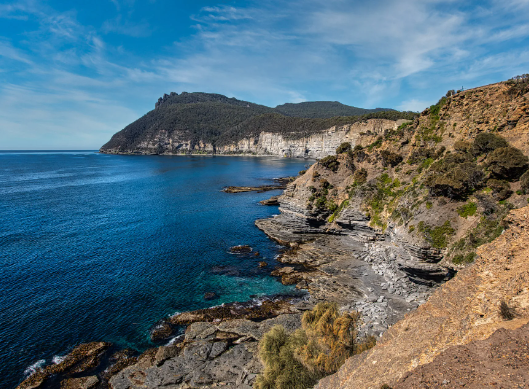
The Fossil Cliffs of Tasmania: A Window into Earth’s Ancient Past
Tasmania, the island state of Australia, is widely known for its rugged coastlines, pristine wilderness, and remarkable geological heritage. Among its many natural wonders, the fossil cliffs scattered along parts of the Tasmanian coast offer a fascinating glimpse into life hundreds of millions of years ago. These cliffs are not only visually striking but also scientifically significant, preserving the remains of ancient marine organisms that once thrived in prehistoric seas. For geologists, fossil hunters, and curious travelers alike, Tasmania’s fossil cliffs provide a rare opportunity to observe the story of Earth’s past written directly into the landscape.
Geological Origins of the Fossil Cliffs
The fossil cliffs of Tasmania were formed through a long geological process that began hundreds of millions of years ago, when much of the region lay beneath ancient oceans. Over time, layers of sediment accumulated on the seafloor. These sediments—composed of sand, mud, shells, and the remains of marine organisms—gradually compacted and hardened into sedimentary rock such as limestone and sandstone.
Within these rock layers, the remains of prehistoric creatures were preserved as fossils. As tectonic forces slowly uplifted the land and erosion exposed the rock layers, the fossils embedded within them became visible along coastal cliffs. Wind, waves, and weather continue to shape these cliffs today, revealing new fossils while slowly wearing the rocks away.
Many of Tasmania’s fossil-bearing rocks date back to the Permian period, roughly 250 to 300 million years ago. During that time, the region was located much farther south and was part of the ancient supercontinent Gondwana. The climate was cooler, and the surrounding seas were rich with marine life.
Types of Fossils Found in Tasmania
The fossil cliffs of Tasmania contain a remarkable variety of marine fossils, providing valuable evidence about ancient ecosystems. Among the most commonly discovered fossils are brachiopods, which resemble clams but belong to a distinct group of marine animals that were extremely abundant in prehistoric oceans.
Trilobite fragments are also occasionally found, representing one of the most famous groups of extinct arthropods that dominated ancient seas for hundreds of millions of years. In addition, fossils of bryozoans, crinoids, and early mollusks appear in the rock layers, each offering clues about the biodiversity of ancient marine environments.
These fossils reveal that Tasmania’s prehistoric seas supported complex ecosystems with numerous species interacting within reef-like communities. Studying these fossils allows scientists to reconstruct ancient food chains, environmental conditions, and even climate patterns from distant geological periods.
Notable Fossil Cliff Locations
Several locations around Tasmania are particularly known for their fossil-rich coastal formations. One of the most famous is Fossil Cove near Hobart, where Permian sedimentary rocks contain abundant marine fossils. The cliffs and rocky shoreline at this site provide excellent opportunities for observing fossils embedded directly in the rock.
Maria Island is another well-known location where visitors can explore fossil-bearing rocks while also enjoying stunning coastal scenery and wildlife. The island’s geology preserves clear examples of sedimentary layering, offering insight into the processes that formed the region millions of years ago.
Other coastal areas around Tasmania also contain smaller fossil exposures, and careful observation often reveals fossil shells or patterns within the rock surfaces. However, many of these sites are protected, and collecting fossils may be restricted in order to preserve their scientific value.
The Scientific Importance of Fossil Cliffs
Tasmania’s fossil cliffs are more than just scenic geological features—they are important scientific resources that help researchers understand Earth’s ancient environments. Fossils preserved in these cliffs allow scientists to study evolutionary history, track changes in biodiversity, and analyze how ecosystems responded to past climate shifts.
Because many of Tasmania’s fossil sites contain well-preserved marine communities, they provide important data for studying the Permian period and the broader history of Gondwana. These records help scientists compare fossil evidence across different continents that were once connected within the ancient supercontinent.
In addition, fossil cliffs serve as natural laboratories for geology students and researchers who study sedimentary structures, fossil preservation, and coastal erosion processes.
Experiencing Tasmania’s Fossil Cliffs Today
Today, Tasmania’s fossil cliffs attract visitors from around the world who are interested in geology, natural history, and outdoor exploration. Walking along these coastal formations allows travelers to observe millions of years of history carved into the rocks.
Interpretive signs at some sites explain the fossils and geological layers visible in the cliffs, helping visitors understand the ancient environments they represent. Guided tours and educational programs also provide deeper insights into Tasmania’s geological heritage.
However, visitors are encouraged to respect conservation rules and avoid removing fossils from protected areas. Preserving these sites ensures that future generations can continue to study and appreciate the remarkable geological history recorded within Tasmania’s fossil cliffs.
A Natural Archive of Earth’s History
The fossil cliffs of Tasmania stand as silent archives of the planet’s distant past. Each layer of rock and every fossil shell embedded within it represents a chapter in Earth’s long geological story. From ancient marine ecosystems to continental drift and coastal erosion, these cliffs reveal the dynamic processes that have shaped our world.
For those fascinated by the history of life and the evolution of landscapes, Tasmania’s fossil cliffs offer an unforgettable reminder that the ground beneath our feet holds the traces of an ancient and ever-changing Earth.