
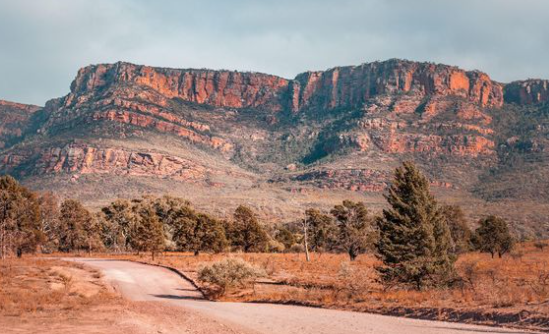
Stretching across South Australia, the Flinders Ranges present one of the most compelling geological narratives on Earth. For geographers, geologists, and curious travelers alike, this rugged terrain offers more than scenic beauty—it is a living archive of Australia’s ancient past. From folded mountain belts to fossil-rich strata, the ranges reveal processes that span hundreds of millions of years, making them an essential case study in Earth science.
The Origins: Sedimentation in Ancient Seas
The geological story of the Flinders Ranges begins over 800 million years ago, when much of the region lay beneath shallow inland seas. During this time, layers of sediment—composed of sand, silt, and organic material—accumulated gradually on the seafloor. These deposits eventually lithified into sedimentary rocks such as sandstone and shale.
Of particular importance is the Ediacaran biota, first discovered in this region. These fossils represent some of the earliest known complex life forms on Earth, dating back around 560 million years. Their presence not only anchors the Flinders Ranges in global geological significance but also provides insight into the evolution of early multicellular organisms.
Mountain Building: Folding, Faulting, and Uplift
The dramatic topography we see today did not emerge quietly. Around 500 million years ago, tectonic forces associated with the Delamerian Orogeny compressed these sedimentary layers. The immense الضغط caused the rocks to fold, fault, and uplift, forming the elongated ridges and valleys characteristic of the Flinders Ranges.
One of the most iconic features, Wilpena Pound, is a natural amphitheater formed by this folding process. Its structure vividly illustrates how horizontal sedimentary layers can be bent into curved formations under tectonic stress, offering a textbook example of orogenic activity.
Erosion and Exposure: Sculpting the Modern Landscape
Following uplift, millions of years of erosion began to shape the ranges into their present form. Wind, water, and temperature fluctuations gradually wore down the mountains, exposing older rock layers beneath. This prolonged denudation is why the Flinders Ranges today are relatively low compared to younger mountain systems, yet geologically far older.
Erosional processes have also enhanced the visibility of stratification, allowing scientists to “read” the rock record like pages in a book. Each layer preserves clues about past environments—whether marine, glacial, or arid—making the region invaluable for reconstructing Earth’s climatic history.
A Window into Climate and Environmental Change
The Flinders Ranges are not just about tectonics; they also document significant climatic transitions. Geological evidence in the area points to ancient glaciation events, including deposits linked to global “Snowball Earth” periods. These findings suggest that Australia, now largely arid, once experienced dramatically different environmental conditions.
By studying these records, geographers gain insight into long-term climate variability and Earth system processes. The ranges thus serve as a natural laboratory for understanding how landscapes respond to shifting environmental forces over geological time.
Cultural and Scientific Significance
Beyond their geological importance, the Flinders Ranges hold deep cultural value for the Adnyamathanha people, whose connection to the land spans tens of thousands of years. Their knowledge systems and stories often align with geological features, offering a complementary perspective on the landscape’s history.
Scientifically, the region continues to attract researchers from around the world. Its well-preserved rock sequences, fossil sites, and structural features make it a cornerstone for studies in stratigraphy, paleontology, and tectonics.
Conclusion: Reading Earth’s Story in Stone
The Flinders Ranges stand as a profound testament to the dynamic processes that have shaped our planet. From ancient समुद्र floors and early life forms to tectonic upheaval and relentless erosion, every ridge and valley tells part of a much larger story.
For a geography-focused audience, the significance of this region lies not only in its features but in its narrative continuity. The Flinders Ranges remind us that landscapes are not static—they are evolving records of Earth’s history, waiting to be read by those who know where, and how, to look.